Understanding Bitcoin Yield on Solana: Zenrock Founders AMA Recap
The Zenrock founders AMA focused on one question: where does zenBTC yield come from and can it scale sustainably? A breakdown of fee-based yield, native BTC returns, and the long-term vision for Bitcoin in DeFi.
The Zenrock founders AMA with @ad1_onchain, @Jack_Krevitt1, and the Zenrock community focused on a single question facing Bitcoin on Solana: where does yield come from and can it scale sustainably over time.
The discussion framed zenBTC as a response to the structural weaknesses of existing wrapped Bitcoin models, particularly centralized custody and incentive-driven growth. From the outset, the team emphasized that zenBTC was built to be a long-term asset for DeFi rather than a short-term yield product.
Why zenBTC Exists
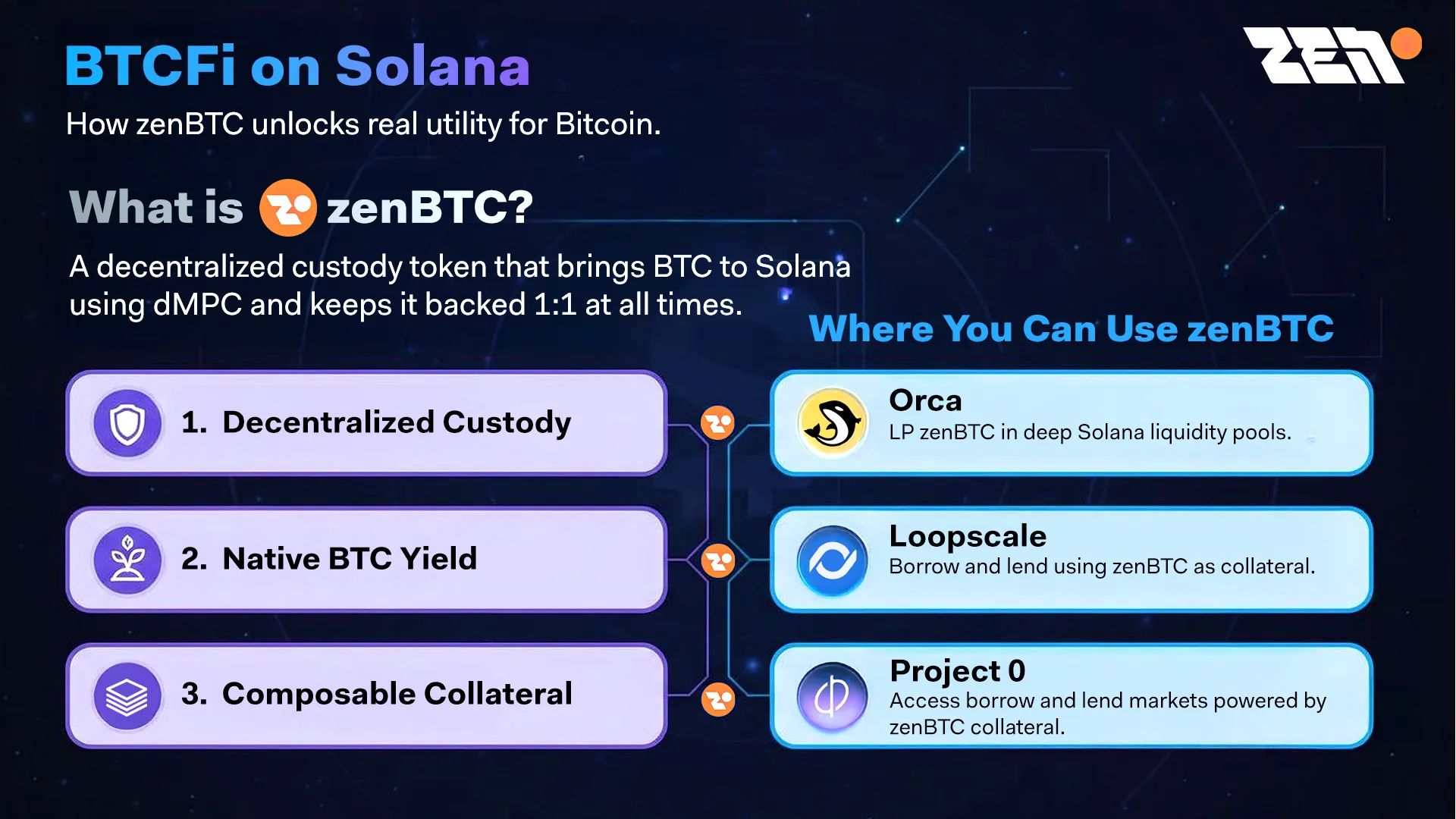
zenBTC was designed after it became clear that many wrapped Bitcoin models relied on trust assumptions that conflicted with decentralized systems. The goal was to create a Bitcoin asset that could move through DeFi while remaining securely custodied and economically productive.
Jack explained that relying on centralized custodians to issue Bitcoin on decentralized platforms does not make sense, and that zenBTC was built to remove that contradiction entirely.
The Core Design Principle: Fee Based Yield
Instead of relying on emissions or incentives, zenBTC v2 generates yield from real protocol fees earned across the Zenrock ecosystem. These fees scale with actual usage, making yield a function of economic activity rather than marketing spend.
“
Fees are the only thing that scale as usage and TVL scale.
”— Jack Krevitt
This approach aligns users with protocol growth and avoids the boom and bust cycles common in incentive-driven yield models.
Transparent, Native BTC Yield
Yield generated by zenBTC is paid as native Bitcoin on the Bitcoin blockchain. This keeps returns transparent, verifiable, and directly tied to real activity.
“
It’s in your wallet every day in Bitcoin, and it’ll still be there next year.
”— Adi
Rather than points or abstract accounting, zenBTC holders can see yield materialize directly as Bitcoin.
Letting the Market Set the Yield
Zenrock does not target or fix an APY for zenBTC. Instead, the protocol is designed to let market dynamics determine yield over time. As TVL grows and protocol activity expands, yield adjusts naturally. This creates a self-balancing system where supply, demand, and real usage determine returns.
“
We are not trying to set the yield. We let the market find equilibrium.
”— Jack Krevitt
Adi reinforced the point, noting that protocol activity expands the fee pool as adoption increases, allowing yield to evolve without artificial controls.
Early Traction and Adoption
Since launch, zenBTC has reached roughly $5M in TVL and processed more than $50M in cumulative trading volume. It is now integrated across major Solana DEXes, lending markets, and liquidity vaults through organic adoption. Adi highlighted that these integrations happened without inorganic incentives and reflect real user demand for a Bitcoin asset designed for DeFi.
Long Term Vision for Bitcoin in DeFi
The founders closed by outlining a future where Bitcoin becomes a core asset in DeFi, used for trading, lending, and credit rather than sitting idle.
Jack described a world where institutions choose Bitcoin instruments that earn yield while being used day to day, similar to how money market funds replaced idle cash. Adi added that zenBTC is positioned to become premium collateral, allowing users to borrow, trade, and deploy capital without selling their Bitcoin.
The AMA ended with a clear takeaway: zenBTC is designed to compound real usage over time, with yield rooted in protocol economics rather than short-lived incentives.