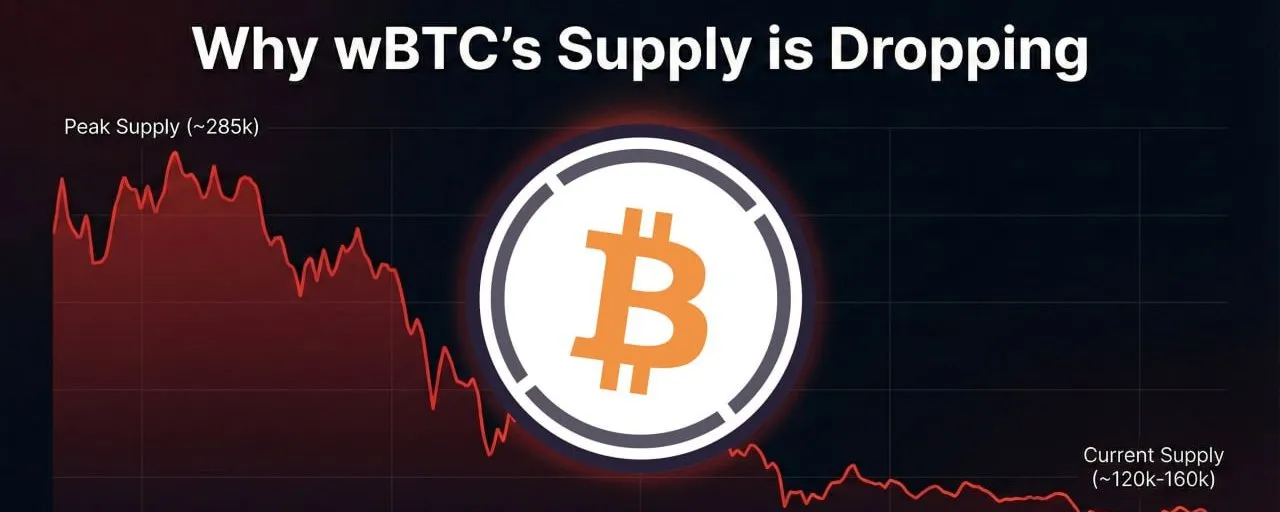
Why wBTC's Supply is Dropping
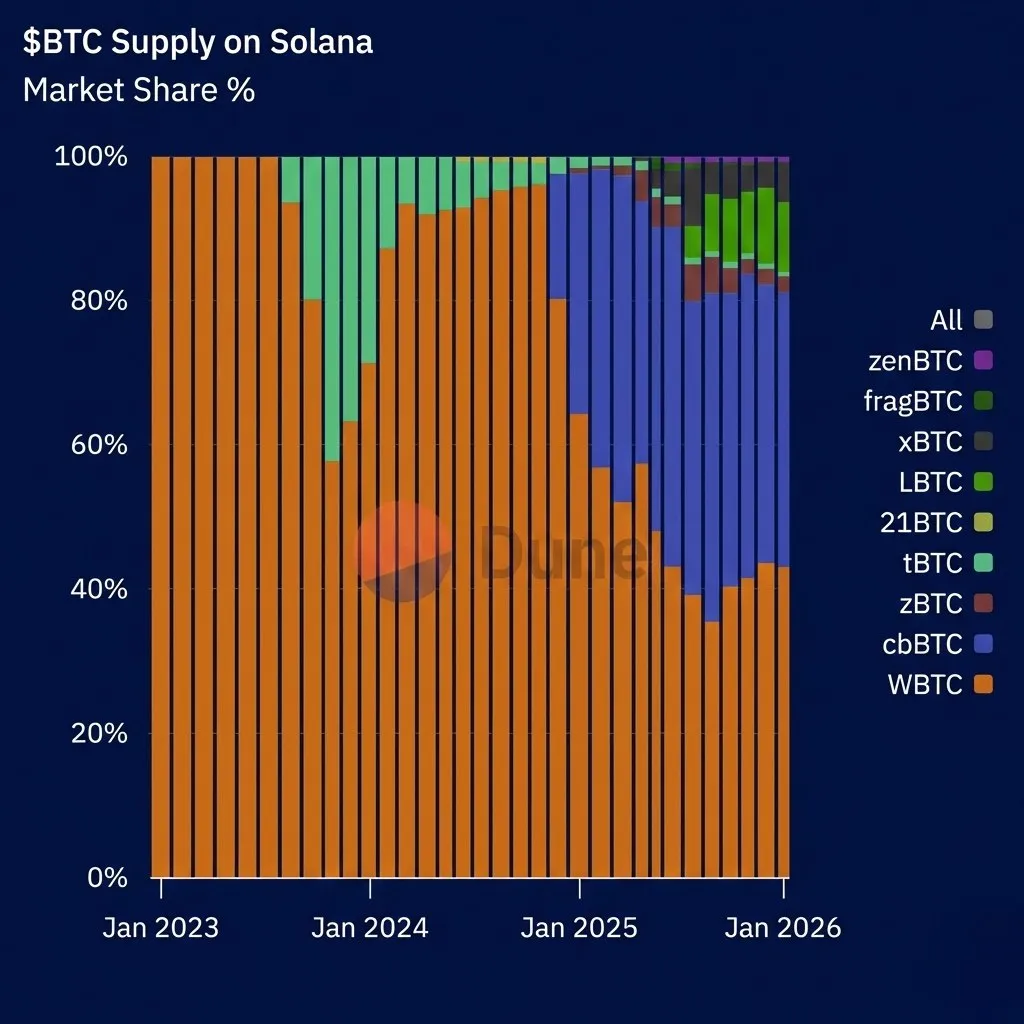
In early 2023, wBTC controlled nearly the entire wrapped BTC supply on Solana. By early 2026, that dominance has fallen to roughly 45%. This is not a temporary rotation — it's structural fragmentation driven by changing custody expectations, yield demand, and institutional participation.
In early 2023, Wrapped Bitcoin (wBTC) effectively was Bitcoin on Solana. It controlled nearly the entire wrapped BTC supply.
By early 2026, that dominance has fallen to roughly 45%.
This is not a temporary rotation. It’s structural fragmentation driven by changing custody expectations, yield demand, and institutional participation.
1. Custody Risk Became a Core Consideration
wBTC relies on a centralized custodian model where one primary entity holds the underlying BTC.
As more capital flowed into Solana, scrutiny increased:
- Regulatory exposure
- Counterparty dependency
- Operational concentration
- Potential restrictions or freezes
When billions secure onchain activity, single points of failure become harder to ignore. Capital began rotating toward models that distribute control rather than concentrate it.
This is where zenBTC stands out. Instead of relying on one centralized custodian, zenBTC distributes custody across independent operators that co-authorize transactions programmatically. No single entity controls the underlying BTC.
That architecture directly addresses the systemic risk concerns that surfaced around traditional wrapped models.
2. Institutions Want Institutional Rails
As traditional finance moves onchain, custody standards rise.
Large allocators require:
- Clear legal frameworks
- Auditable reserves
- Operational accountability
- Transparent infrastructure
Institutional capital does not tolerate ambiguity. As banks and funds gain Bitcoin exposure on Solana, supply reallocates toward models that can demonstrate verifiable backing and structured operations at scale.
Importantly, this does not automatically favor centralized custody. zenBTC shows that distributed custody can coexist with transparency and institutional-grade rigor, spreading risk across independent operators rather than concentrating it in a single entity.
3. Yield Is Now a Baseline Expectation
Bitcoin bridged to Solana is no longer just a representation of BTC. It is expected to participate in DeFi.
Users increasingly want their BTC to:
- Earn sustainable yield
- Serve as collateral across lending markets
- Integrate with liquidity protocols
- Maintain security without sacrificing capital efficiency
Yield-bearing BTC changes capital allocation behavior. When one model offers stronger alignment between custody design and productive use of capital, liquidity follows.
zenBTC benefits here because its distributed custody model enables native yield generation tied directly to custody and ecosystem activity, aligning security architecture with economic output.
4. The Market Is Maturing
Wrapped BTC is no longer a single category. It is a competitive landscape.
Different users optimize for different priorities:
- Maximum decentralization
- Regulatory clarity
- Sustainable yield
- Deep liquidity
- Composability across protocols
- Censorship resistance
- Institutional compatibility
As those priorities diverge, supply fragments. The decline in wBTC dominance reflects this specialization.
Conclusion
wBTC’s drop from ~100% to ~45% market share on Solana is not a collapse. It is evolution.
Capital is reallocating toward differentiated custody architectures that better match user priorities.
- Some demand institutional-grade frameworks.
- Some demand distributed, decentralized custody.
- Some demand sustainable yield alongside security.
zenBTC is positioned at the intersection of these shifts, combining distributed custody with native yield generation and infrastructure designed to scale with institutional standards.
Bitcoin on Solana is no longer defined by a single wrapped asset. It is defined by choice.